
At Summit Dog and Cat Hospital, we offer many services to help your pet maintain a healthy lifestyle. Our facility offers preventative care, urgent care, and emergency care. With a wellness examination, our veterinarians can determine your pet’s current health status, diagnose potential problems, and design a custom treatment plan.
Eye Care
As part of a comprehensive wellness exam, your pet’s eyes are also checked. Eye care is important for pets of all ages, whether they are indoor or outdoor furry friends. Having your pet’s eyes examined allows the vet to diagnose any potential problems.
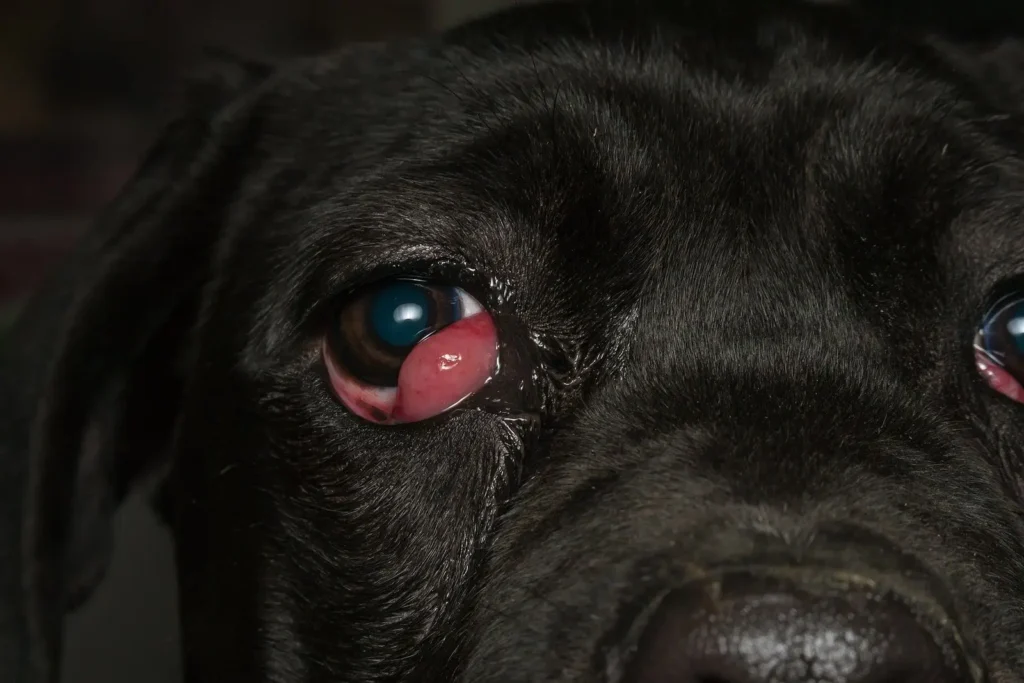
If your pet is experiencing symptoms of eye irritation, such as redness, inflammation, watering, or discharge, or you notice a pink cherry-like protrusion at the inside corner of its eye, your pet may be suffering from a condition known as “cherry eye.” Cherry eye is most prevalent in canines, but felines can also experience the problem.
About Cherry Eye
Cherry eye affects the third eyelid, which is an additional protective layer for the eye. The third eyelid is located inside the pet’s lower lid. It is especially helpful when a pet is hunting or in the event it is in a fight. The third eyelid serves as an important part of the protective tear film, which is produced by a gland inside the third eyelid. The condition results when the third eyelid gland pops out (prolapses) at the lower inside corner of the eye. The size of the pink mass varies. It may be small or large enough to cover the majority of the cornea.
Causes of Cherry Eye
Cherry eye, while a common ailment, is generally found in specific dog breeds. These include the Boston Terrier, French Bulldog, Cocker Spaniel, English Bulldog, Shih Tzu, Bloodhound, Pug, Beagle, and Lhasa Apso. The most affected felines are the Persians and Burmese. What these breeds have in common is a “flat face.”
The third eyelid gland attaches to the inner eye rim. In affected canine and feline breeds, the attachment is not as strong as it is in other breeds, resulting in a prolapse (protrusion). If your pet has this condition, it is important to schedule an examination as soon as possible to determine the best plan of action for treatment and relief.
xContact Our Animal Hospital in Summit, NJ
When your pet is experiencing cherry eye and needs help, contact Summit Dog and Cat Hospital so our veterinarians can provide your pet with the proper treatment that provides relief for your furry family member. We are proud to serve Summit, Short Hills, Millburn, Livingston, Edison, Chatham, Madison, Union, Westfield, Springfield, NJ and the surrounding areas. Call our team today at (908) 273-2200 to learn more or to schedule an appointment.