
A dog that suddenly starts straining in the yard, producing only a small dribble of urine, or licking at himself more than usual is easy to mistake for a simple bladder infection. Sometimes that is exactly what it is. Other times, the real problem is something harder and less obvious, a stone that has formed inside the bladder itself. Knowing what causes bladder stones in dogs helps explain why this is not a condition that clears up on its own the way a mild infection sometimes does.
Bladder stones, also called urinary bladder calculi, are hard mineral deposits that build up gradually inside the bladder. Left alone, they irritate the bladder lining, encourage repeat infections, and in some dogs can move into the urethra and block urine flow entirely, which turns a manageable problem into a true emergency within hours.
This guide covers what causes bladder stones in dogs, the different types that form, how a veterinarian confirms the diagnosis, and what cystotomy surgery actually involves for the dogs that need it.
What Causes Bladder Stones in Dogs
Bladder stones form when minerals that are normally dissolved in urine, mostly struvite or calcium oxalate, crystallize instead and clump together into a solid mass. This does not happen overnight. It usually takes weeks or months of the right conditions lining up before a noticeable stone develops.
Diet, Urine pH, and Mineral Buildup
Urine pH plays a large role in which minerals crystallize. Struvite stones tend to form in urine that is more alkaline, often alongside a bacterial urinary tract infection that raises the pH as a byproduct. Calcium oxalate stones, by contrast, tend to form in urine that runs more acidic and are not linked to infection in the same way. Diet influences both mineral concentration and pH, which is why a veterinarian often reviews what a dog is eating and drinking as part of figuring out why stones formed in the first place.
Breed and Health Factors That Raise the Risk
Some breeds are simply more prone to certain stone types. Dalmatians, for example, process a compound called urate differently and are prone to urate stones regardless of diet. Small breeds like Miniature Schnauzers, Bichon Frises, and Shih Tzus are overrepresented among dogs with calcium oxalate stones, while struvite stones show up more often in dogs with recurring bladder infections. A dog who does not drink much water, or who holds urine for long stretches between bathroom breaks, gives minerals more time and a more concentrated environment to crystallize in.
Sex also plays a role, though not in the same direction for every stone type. Female dogs develop bladder infections more often than males, which puts them at higher risk for infection-related struvite stones. Male dogs are not immune to forming stones in the first place, but their longer, narrower urethra makes them far more likely to suffer a dangerous blockage if a stone does try to pass, which is part of why male dogs showing urinary symptoms are evaluated urgently rather than watched for a few days first. Being overweight or getting little exercise can also contribute indirectly, since a dog who rarely empties its bladder fully gives any crystals already present more time to grow into an actual stone.
Types of Bladder Stones in Dogs
Not every stone is the same, and the type often changes both the treatment and the prevention plan going forward. Two dogs can both be diagnosed with urinary bladder calculi and end up on completely different paths afterward, one managed for months with a prescription diet and the other needing surgery within the week, simply because the mineral makeup of their stones is different.
Stone Type |
Typical Cause |
Commonly Affected Dogs |
| Struvite | Often linked to a bacterial urinary tract infection that raises urine pH | Dogs with recurring bladder infections, more often female dogs |
| Calcium oxalate | Forms in more acidic urine, unrelated to infection | Small breeds such as Miniature Schnauzers, Bichon Frises, and Shih Tzus |
| Urate | A genetic difference in how the body processes uric acid | Dalmatians and dogs with certain liver conditions |
Signs of Bladder Stones in Dogs
Bladder stones do not always cause dramatic symptoms right away, which is part of why they can go unnoticed until they cause a blockage or a stubborn infection.
- Straining to urinate, or producing only small amounts despite appearing to try repeatedly, is one of the most common early signs.
- Blood-tinged or pink-tinged urine often shows up as the stone irritates the bladder lining with movement.
- Frequent trips outside with little to show for it can look like a housetraining lapse but is often a physical symptom instead.
- Licking at the genital area more than usual is a common response to the discomfort stones can cause.
- A change in urine odor or cloudiness sometimes accompanies the infections that often travel alongside struvite stones.
- A male dog who strains repeatedly and produces no urine at all needs emergency care immediately, since this can mean a stone has lodged in the narrower urethra and fully blocked the flow of urine.
How Bladder Stones Are Diagnosed
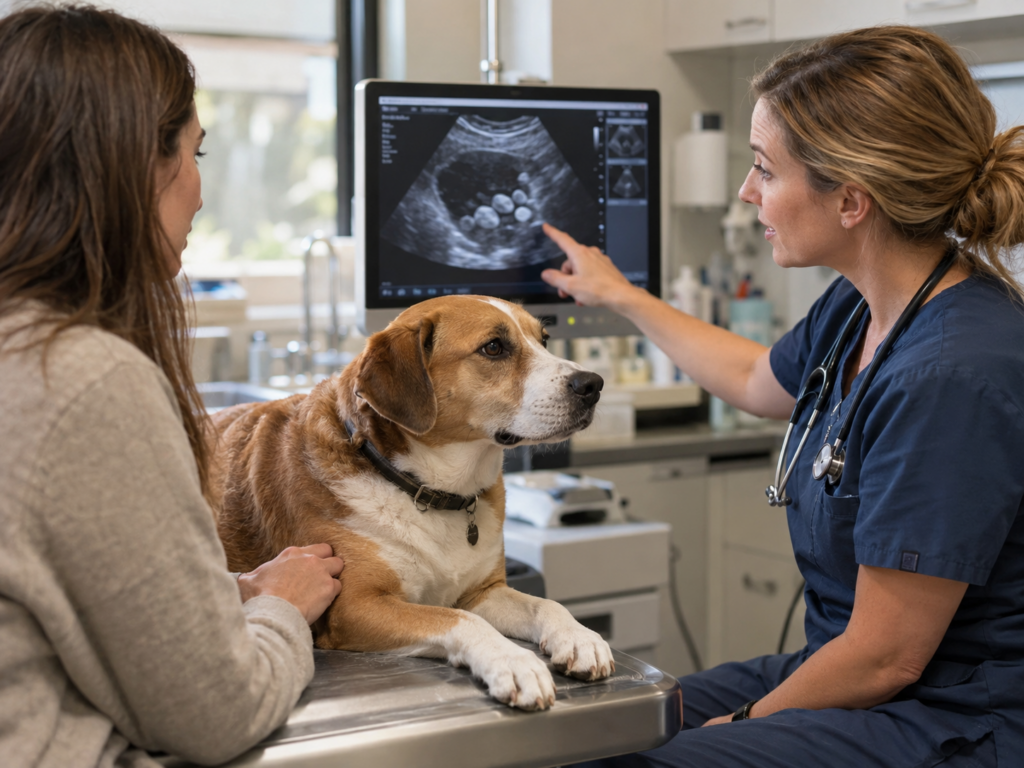
A new patient exam or urgent visit for these symptoms typically starts with a urinalysis, which checks for blood, infection, crystals, and pH imbalances that point toward a stone-forming environment. From there, an x-ray or ultrasound usually confirms whether a stone is actually present, since not every mineral crystal seen under a microscope means a full stone has formed. Because struvite and calcium oxalate stones look different on imaging and respond to different treatments, confirming the type early helps guide the right next step instead of guessing.
Ruling Out Other Causes of Urinary Symptoms
Straining, blood in the urine, and frequent trips outside are not unique to bladder stones. A simple bladder infection can look nearly identical without any stone present at all, and less commonly, a bladder tumor or polyp can cause the same symptoms in an older dog. Bloodwork and a full urinalysis help separate these possibilities early, and imaging settles the question of whether a stone is actually there. Treating a dog for a suspected infection for weeks without imaging, when a stone is the real cause, usually means the symptoms keep coming back no matter how many rounds of antibiotics are tried.
Cystotomy Surgery for Dogs With Bladder Stones
Cystotomy is the surgical procedure used to remove bladder stones directly, and it remains the most reliable option when stones are too large to dissolve through diet, are causing repeated blockages, or need to be removed quickly because of a dog’s discomfort.
Step |
What Happens |
| Pre-surgical workup | Bloodwork and imaging confirm the dog is a safe candidate for anesthesia and pinpoint the stone’s exact location |
| Anesthesia | The dog is placed under general anesthesia and monitored closely throughout the procedure |
| Accessing the bladder | A small incision is made into the abdomen and then into the bladder itself |
| Removing the stones | Stones are removed and the bladder is flushed to clear any remaining fragments or debris |
| Closing and recovery | The bladder and incision are closed in layers, and the dog wakes up under close observation |
Removed stones are typically sent to a lab for analysis, since knowing the exact mineral composition shapes the diet and monitoring plan that follows.
What to Expect on the Day of Surgery
Owners are usually asked to withhold food for several hours before a scheduled cystotomy, since an empty stomach lowers the risk of complications under anesthesia. Water is typically fine up until drop-off unless a veterinarian specifies otherwise. Most dogs are dropped off in the morning, spend the day at the hospital for the procedure and initial recovery, and go home later that same day or the following morning depending on how they respond to anesthesia and how much swelling or discomfort the team observes.
Throughout the procedure, a dog stays on continuous monitoring for heart rate, breathing, and blood pressure, the same standard used for any general anesthesia at Summit. Owners typically receive a call once surgery is finished and again with an update on when the dog is ready to go home, along with written instructions covering the incision, medication, and activity restrictions to review before pickup.
Recovery After Bladder Stone Surgery
The First Two Weeks at Home
Most dogs go home the same day or the following day and need activity restricted for about ten to fourteen days while the bladder incision heals. An e-collar prevents licking at the incision site, and owners are usually asked to watch for normal urination in the days after surgery, since a dog who cannot urinate after coming home needs to be seen again right away. Mild bloody urine for the first few days is common and typically resolves on its own.
A few situations during recovery are worth a call rather than waiting to see if they pass on their own. Straining without producing urine, swelling or discharge at the incision site, ongoing vomiting, or a dog who seems unusually lethargic or painful past the first day or two all warrant a follow-up call. Most recoveries are uneventful, but catching a problem early keeps a minor setback from turning into a bigger one.
Preventing Stones From Returning
Because the underlying cause, whether diet, pH, infection, or genetics, does not disappear just because the stones were removed, prevention depends heavily on that cause. Dogs prone to struvite stones often need infections treated promptly and monitored urine pH going forward. Dogs prone to calcium oxalate stones may benefit from a therapeutic diet and increased water intake to keep urine more dilute. Follow-up urinalysis at future wellness exams helps catch a new stone forming long before it becomes large enough to cause symptoms again.
Simple daily habits make a real difference alongside any diet change. Fresh water available at all times, more frequent bathroom breaks so urine is not held for hours at a stretch, and keeping a dog at a healthy weight all support a bladder environment that is less friendly to crystal formation. None of these habits guarantee a dog will never form another stone, but together with the right diet and regular monitoring, they meaningfully lower the odds.
When Bladder Stones Become a Medical Emergency
Bladder stones themselves are rarely an immediate emergency, but a stone that migrates into the urethra can be. This risk is highest in male dogs, whose urethra is longer and narrower than a female dog’s, making it easier for a stone to become lodged. A dog straining repeatedly with little or no urine coming out, especially if he seems increasingly restless, painful, or lethargic, needs to be seen the same day. Left untreated, a full blockage causes the bladder to overfill and can lead to kidney damage within a day or two.
If these signs show up outside of regular hours, do not wait until the next available daytime appointment to see whether things improve on their own. Calling ahead so the team knows a dog is on the way, or heading straight to an emergency animal hospital if Summit is closed, gives the best chance of resolving a blockage before it causes lasting damage.
How Summit Supports Dogs With Bladder Stones
Diagnosing the type of stone and choosing the right treatment, whether that means a therapeutic diet, treating an underlying infection, or moving forward with cystotomy surgery, depends on a dog’s specific situation. The team at Summit Dog and Cat Hospital works through imaging, bloodwork, and surgical services together so a dog gets the right treatment the first time rather than a guess that needs revisiting. Same- and next-day appointments make it easier to get a straining or uncomfortable dog seen quickly. If your dog is showing signs of bladder stones, book an appointment online so the team can find out what is going on and recommend next steps.
Sources
Journal of Veterinary Internal Medicine, ACVIM Small Animal Consensus Recommendations on the Treatment and Prevention of Uroliths in Dogs and Cats (2016). Peer reviewed specialist consensus statement. Supports these points: struvite and calcium oxalate stones are treated and prevented differently, some stones can be dissolved while others must be removed, and prevention plans continue after treatment.
Merck Veterinary Manual, Overview of Urolithiasis in Small Animals (accessed 2026). Peer reviewed professional veterinary reference. Supports these points: stones cause signs by blocking urine flow and irritating the bladder lining, crystals in the urine do not by themselves mean a stone has formed, and urethral blockage is a risk.
University of Minnesota, Minnesota Urolith Center (accessed 2026). University veterinary stone analysis lab. Supports these points: removed stones are sent to a lab for analysis, and the result guides the dissolution and prevention plan.
Frequently Asked Questions
Q: What causes bladder stones in dogs?
A: Bladder stones form when minerals in the urine, most often struvite or calcium oxalate, crystallize and clump together instead of staying dissolved. Diet, urine pH, recurring infections, and breed-related genetics all influence which type of stone a dog is likely to develop.
Q: Can bladder stones in dogs be treated without surgery?
A: Some struvite stones can dissolve with a prescription diet designed to change urine composition, though this takes weeks and does not work for every stone type. Larger stones, calcium oxalate stones, or stones causing repeated blockages usually need cystotomy surgery instead.
Q: How do I know if my dog has bladder stones instead of a bladder infection?
A: The symptoms often look identical from the outside, which is exactly why a urinalysis and imaging are needed to tell the difference. A bladder infection alone will not show up on an x-ray, while a stone typically will.
Q: How long does it take a dog to recover from cystotomy surgery?
A: Most dogs are back to normal activity within two to three weeks, though strict rest is usually needed for the first ten to fourteen days while the bladder incision heals fully.
Q: Will my dog get bladder stones again after surgery?
A: It depends on the cause. Dogs prone to struvite stones or calcium oxalate stones can develop new ones without ongoing diet changes and monitoring, which is why prevention becomes part of a dog’s long-term care plan after surgery. Regular follow-up urinalysis makes it far more likely that a new stone is caught early, while it is still small enough to manage without another surgery.